Regulations · 06 of 11
U-values and window energy ratings explained
A U-value measures how fast heat escapes, so lower is better. Replacement windows in England and Wales must achieve 1.4 W/m²K or better, or Window Energy Rating band B. A rating counts the solar gain a window lets in as well as the heat it loses, which is why the two measures can disagree.
These two numbers appear on every quote and salespeople lean on them heavily. They measure different things, and knowing which is which stops you paying for the wrong improvement.
U-value: heat going out
The U-value is watts lost per square metre per degree of temperature difference. Lower is better, and the units are W/m²K.
- Single glazing: around 4.8 to 5.8. Effectively a hole in the wall.
- Early double glazing: roughly 2.8 to 3.2.
- Modern double glazing: around 1.2 to 1.6.
- Good triple glazing: roughly 0.8 to 1.1.
Check whether a quoted figure is for the whole window or just the glass. The glass alone always looks better, because the frame is the weaker part, and the regulations apply to the whole window.
Window Energy Rating: the net picture
A WER runs from A++ down to G and nets off three things: heat lost through the window, solar heat gained through it, and air leakage around it.
That is why a window with a slightly worse U-value can carry a better rating, if it admits more free solar heat. On a south-facing elevation that gain is real. On a north-facing one there is very little of it, so the U-value is the number that matters.
What actually moves the number
- Low-emissivity coating. A microscopically thin metal-oxide layer that reflects heat back inside. Standard on anything modern.
- Argon fill. Argon conducts less heat than air. Cheap to add and worth having.
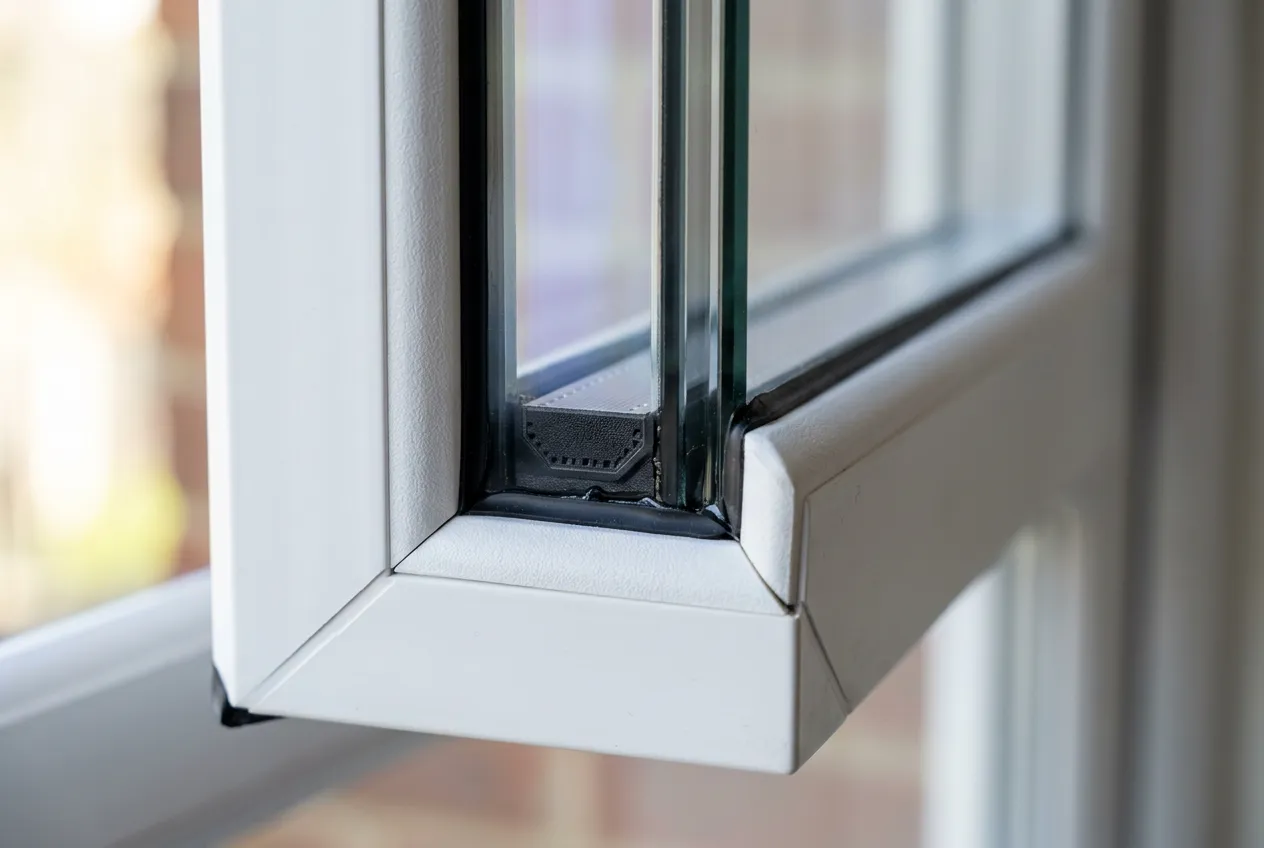
- Warm-edge spacer bars. The strip separating the panes. Traditional aluminium spacers conduct heat straight around the edge of the unit; a warm-edge spacer does not, and it also reduces condensation on the glass edges.
- Frame material and construction. Chambers in uPVC, thermal breaks in aluminium.
Argon and warm-edge spacers are the best value items on that list. Ask whether they are included rather than assuming.
Questions
- Is a lower U-value always better?
- For heat loss, yes. On a sunny south-facing elevation it is worth also looking at the energy rating, because a window that lets in more solar gain can perform better overall even with a marginally higher U-value.
- What U-value do I need by law?
- For replacement windows in England and Wales, 1.4 W/m²K or better for the whole window, or Window Energy Rating band B. Doors have their own equivalent requirement.
- Do I need A++ rated windows?
- Rarely worth the premium on its own. The jump from old single or early double glazing to any compliant modern window is where nearly all the benefit is. The last few rating bands cost disproportionately more for a small gain.
Note This guide is general information about England and Wales, not advice about your specific property. TrustedGlazing is an introducer and does not install, survey or quote. Rely on your installer's survey and your local authority for decisions about your own home.