Doors
Composite doors
A composite door costs around £900 to £2,350 supplied and fitted. It is built from a solid core, usually timber or high-density foam, wrapped in a glass-reinforced plastic skin. That construction gives it the solidity of timber without the maintenance, and it is the most common recommendation for a UK front door.
Composite doors are sold hard and the marketing tends to blur together. The differences that actually affect how the door performs are the core, the skin and the thickness.
Indicative guide, not a quote
per door, supplied and fitted
£900 – £2,350
These figures come from published industry price guides, not official statistics, and several of those sources are installers or comparison sites with a commercial interest. They are a starting point for a conversation, not a quote. Your installer sets the actual price after measuring.
Expertsure composite door cost guide · checked 2026-10-09
Solid timber core versus foam core
This is the single biggest quality difference between two composite doors that look identical.
A solid timber core gives the door weight and a reassuringly dense sound when it closes, and holds fixings well. A foam core is lighter and insulates slightly better in isolation, but feels noticeably less substantial and is the usual construction at the cheaper end.
Ask directly which you are being quoted. Both are sold as composite doors.
Thickness and the GRP skin
Composite doors are typically 44mm or 48mm thick. The thicker slab is more rigid and generally takes better hardware.
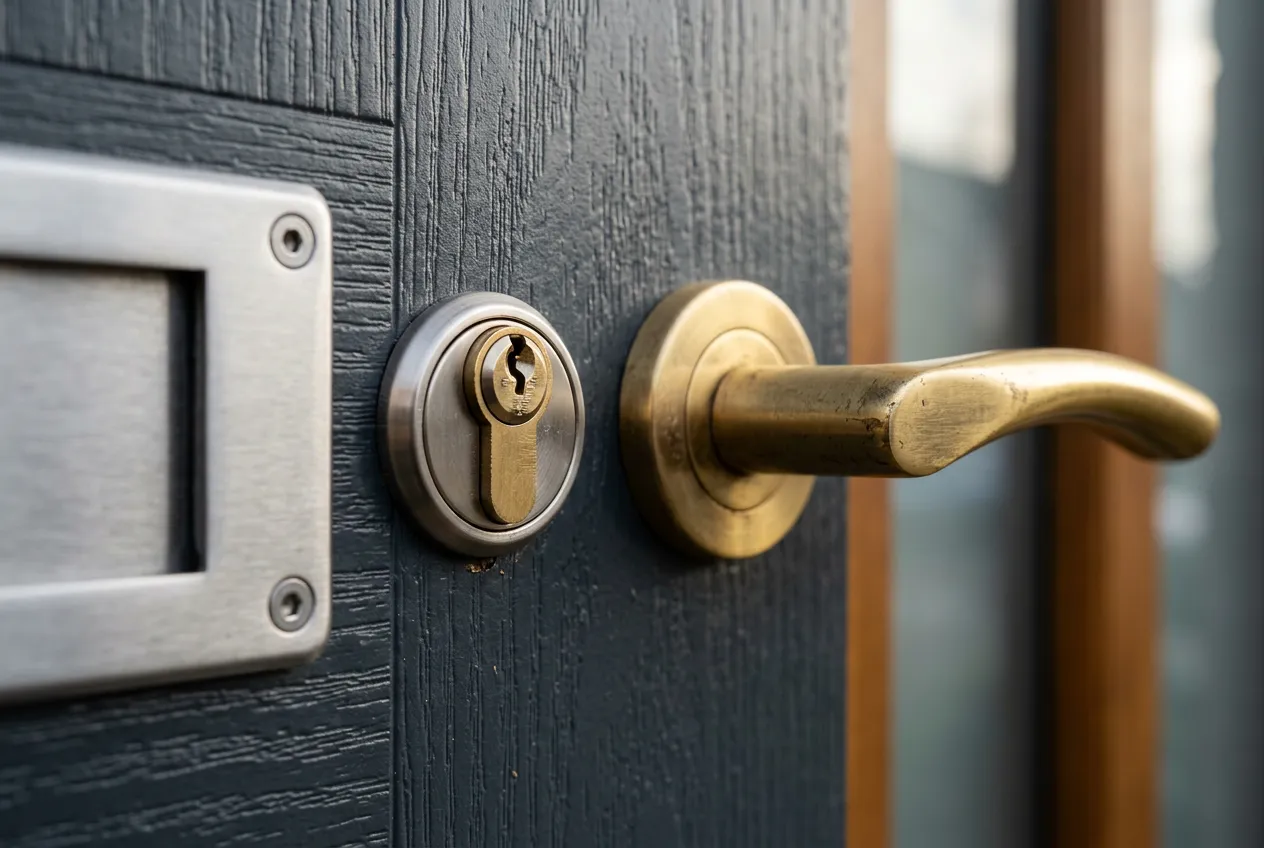
The skin is glass-reinforced plastic, moulded with a woodgrain texture and coloured through rather than painted, so a scratch does not show a different colour underneath. It does not need repainting and will not rot, which is the main practical advantage over timber.
What a good specification looks like
Beyond the slab itself, the things worth confirming on a quote are the locking system, the cylinder, the glass and the guarantee.
- PAS 24 tested doorset, not just a PAS 24 lock in an untested door.
- Anti-snap cylinder to TS007 three-star or Sold Secure Diamond.
- Laminated glass in any pane within reach of the handle.
- A written guarantee covering the slab, the hardware and the installation, with the terms of each stated separately.
Composite doors: common questions
- How long do composite doors last?
- The slab itself should last well beyond twenty years. As with most doors, the hinges, cylinder and multi-point lock are the parts most likely to need attention first.
- Do composite doors fade?
- Darker colours on a south-facing elevation can lose some depth over many years. The colour runs through the GRP skin rather than sitting on top, so fading is gradual rather than patchy, and scratches do not expose a different colour.
- Are composite doors better than uPVC?
- For a front door, generally yes. They are more solid, more secure as standard and feel considerably better to use. uPVC remains a reasonable choice for a back door or on a tighter budget.
Other doors
-
Front doors
£900 – £2,350 fitted
A new front door costs £700 to £2,800 fitted. Composite, uPVC, aluminium and timber compared, and why the lock matters more than the door.
-
uPVC doors
£700 – £1,400 fitted
uPVC doors cost £700 to £1,400 fitted. Where they make sense, why cheap ones drop on their hinges, and the cylinder upgrade worth paying for.
-
Aluminium doors
£1,400 – £2,800 fitted
Aluminium doors cost £1,400 to £2,800 fitted. Why the material handles tall, heavily glazed doors, and how to match it across the house.
-
Bi-fold doors
£3,000 – £7,500 fitted
Aluminium bi-fold doors cost £3,000 to £7,500 fitted. Panel counts, why you need a traffic door, and how they compare with sliding doors.
-
Sliding patio doors
£1,500 – £4,000 fitted
Sliding patio doors cost £1,500 to £4,000 fitted. Bigger panes than bi-folds, no lost space, and why lift-and-slide changes how they feel.
-
French doors
£1,200 – £2,950 fitted
French doors cost £1,200 to £2,950 fitted. Usually the sensible answer up to two metres, with no track or running gear to wear out.
TrustedGlazing does not make, supply or fit windows and doors, and the prices above are published industry guides rather than our own. We match your enquiry to one vetted local installer, who quotes and contracts with you directly.